
5.2%, big problem? Not at all

The financial press rarely misses an opportunity to interpret a sharp rise in long-term Treasury yields as a referendum on US fiscal credibility. Once the 30-year Treasury yield climbed above 5.2%, reaching levels not seen since 2007, familiar explanations immediately resurfaced. Investors were supposedly demanding compensation for an exploding fiscal deficit. Bond vigilantes had allegedly returned. Others argued that markets were beginning to lose confidence in the dollar itself. Or the inflation is unanchored. All these arguments were already touched upon in this post, but here we are again!
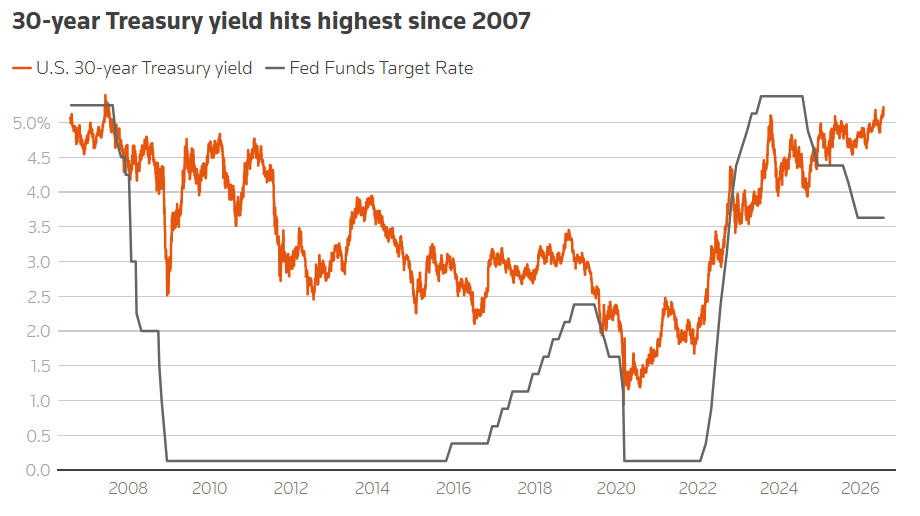
Source: Reuters
The problem is that the behavior of the Treasury curve simply does not support these conclusions.
Looking only at the long bond while ignoring the rest of the curve produces an incomplete interpretation of what markets are actually pricing. The Treasury market does not trade as thirty independent securities. It trades as an interconnected term structure where each maturity reflects different expectations regarding monetary policy, economic growth, but also the evolution of the policy rate. The recent move therefore should be interpreted as another phase of yield curve normalization following a reduction in the probability of additional Federal Reserve tightening rather than evidence of an inflation panic or a buyers’ strike against US government debt.
The distinction matters because the implications are fundamentally different.
At the July FOMC meeting, the Federal Reserve kept the federal funds target unchanged despite three dissents favoring an immediate increase (9-3). Chairman Kevin Warsh maintained an unmistakably hawkish tone, emphasizing that inflation risks remained significant and that policymakers should not become complacent. Nevertheless, markets interpreted the meeting as reducing the probability of an imminent rate hike rather than increasing it. The two-year Treasury yield declined materially immediately after the meeting, precisely because it is the maturity most sensitive to expected Fed policy.
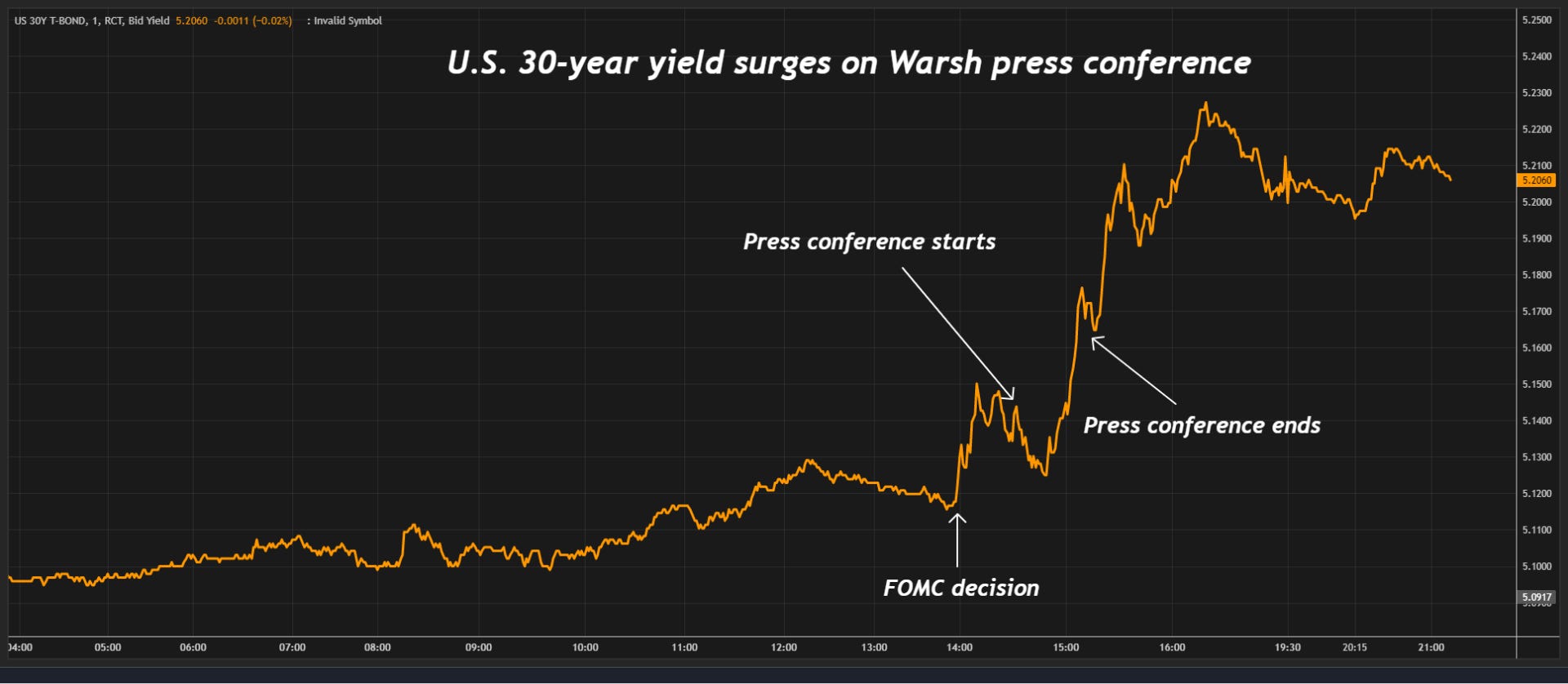
Source: Reuters
The 10-year yield changed comparatively little, while the 30-year yield drifted higher. But no matter what, that is not the profile of an inflation scare. If anything, at least to me, this is a classic example of a bull steepening process in which the front end rallies more aggressively than the long end while the curve gradually returns toward a more normal upward slope.
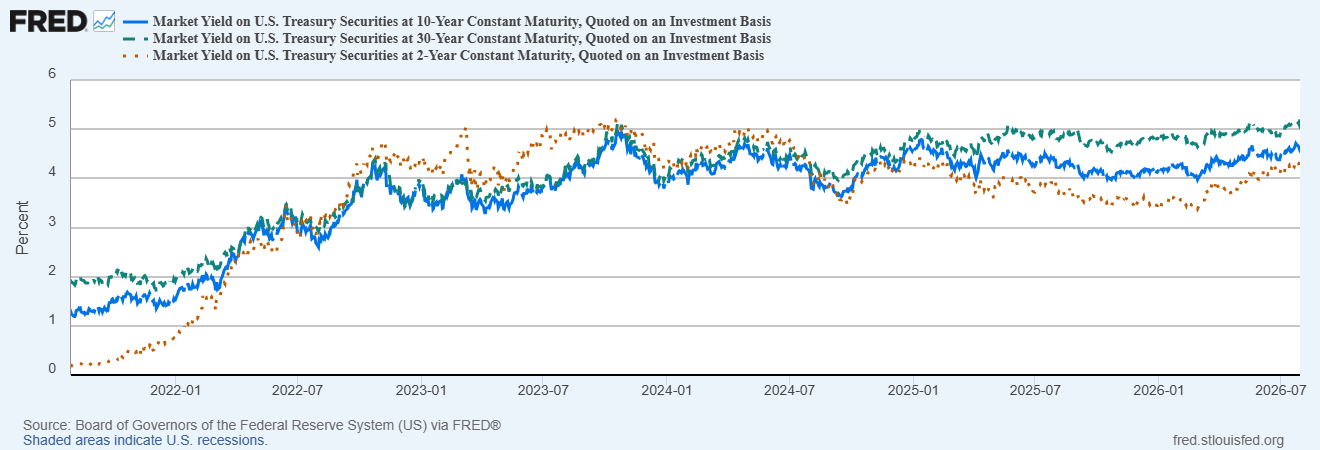
Source: Federal Reserve Bank of St. Louis
Understanding this distinction requires moving beyond the simplistic idea that every increase in long term yields must reflect deteriorating confidence.
Historically, yield curve inversions emerge when monetary policy becomes substantially tighter than what markets consider consistent with long run equilibrium. The inversion is therefore an artificial configuration generated by policy rates remaining above longer-term expectations for nominal growth. When investors begin to assign a lower probability to further tightening, the first reaction almost always appears at the front of the curve because those maturities directly reflect expected policy rates. The long end behaves differently (especially since they are out of the control of a central bank). Rather than collapsing alongside the front end, it often adjusts more slowly, producing a steepening of the curve.
If investors genuinely believed inflation were spiraling out of control, they would demand higher compensation across the entire intermediate and long end of the curve. Inflation expectations would push five-year, seven-year and ten-year yields sharply higher alongside the thirty-year bond. Instead, much of the recent adjustment has been concentrated at the very long end while policy-sensitive maturities have declined. The market is therefore differentiating between near-term monetary policy and long-term equilibrium. They are not pricing a generalized inflation shock.
This also explains why interpreting the move as a fiscal event is problematic. The fiscal narrative implicitly assumes that investors have suddenly become unwilling to finance US government deficits. Yet Treasury auctions continue to clear smoothly, bid-to-cover ratios remain historically healthy, and foreign participation has not collapsed. For instance, the last 30y auction drew a bid-to-cover ratio of 2.44x, in line with recent sales. Indirect bidders, mostly foreign investors, took nearly 78% of the supply. Moreover, the Treasury market remains the deepest and most liquid sovereign bond market in the world, as we discussed so many times on this blog.
The notion of bond vigilantism also struggles to explain the relative behavior of different maturities. A genuine buyers’ strike would normally produce a broad repricing of duration risk, not an isolated adjustment concentrated toward the longest maturity. Even more importantly, such an episode would likely coincide with widening inflation breakevens and substantial increases in Treasury term premia across maturities. That is not what current market indicators suggest. Not even remotely close, see the image below.
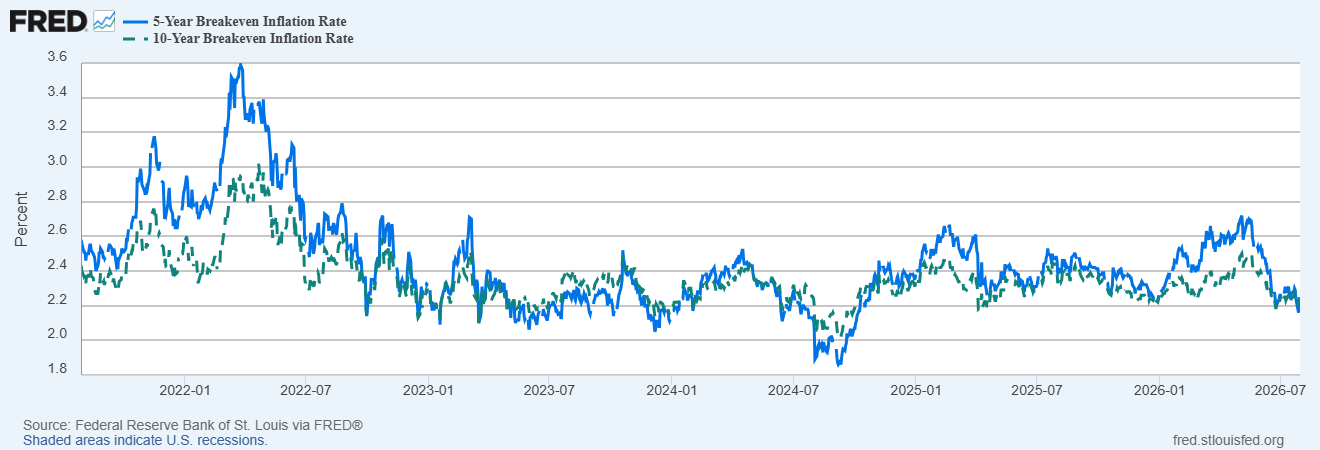
Source: Federal Reserve Bank of St. Louis
This distinction becomes especially important when considering recent developments in energy markets. Oil prices undoubtedly increased following geopolitical disruptions in the Middle East. Conventional commentary immediately concluded that higher oil prices necessarily imply higher inflation and therefore higher Treasury yields. Yet history demonstrates that oil shocks are considerably more complex than this simple relationship suggests.
An increase in oil prices simultaneously raises measured inflation while reducing real disposable income. Higher gasoline prices function as a tax on consumption. Households devote a larger share of their income to energy expenditures, leaving fewer resources available for discretionary consumption. Firms experience higher input costs while demand simultaneously weakens. Investment slows. Consumption slows. Credit demand deteriorates. About these things I discussed here or here.
Consequently, long-term Treasury yields need not rise because investors expect permanently higher inflation. They may instead reflect uncertainty regarding future monetary policy responses. This distinction is essential. Markets increasingly appear to believe that central banks could eventually tighten policy not because underlying demand is overheating but because policymakers continue interpreting temporary energy price increases through conventional inflation-targeting frameworks. In other words, markets are pricing the probability of future policy mistakes rather than persistent inflation itself.
Europe offers perhaps the clearest historical parallel. During 2008 and again in 2011, the European Central Bank tightened monetary policy largely in response to commodity-driven inflation despite rapidly deteriorating economic conditions. Those decisions are now widely regarded as policy errors because the inflation shock originated from supply disruptions while demand remained weak.
The current Treasury curve resembles markets assigning a non-trivial probability that central banks could once again overreact to temporary commodity-price movements. This interpretation also aligns remarkably well with recent macroeconomic data. Second-quarter GDP figures across advanced economies appeared superficially encouraging. Consumer spending improved modestly in the United States. Several European economies avoided outright contraction. And even so, the strength appears driven by temporary factors including front-loaded purchases and AI-related capital expenditure concentrated within a relatively narrow set of firms.
This combination hardly resembles the environment associated with sustained inflationary expansions. Instead, it resembles what we have repeatedly observed since late 2023: short-lived mini-cycles generated by temporary shocks rather than durable recoveries. Each time activity stabilizes, financial markets quickly extrapolate “resilience”. Each time, subsequent data reveal that much of the improvement reflected temporary distortions rather than genuine cyclical acceleration.
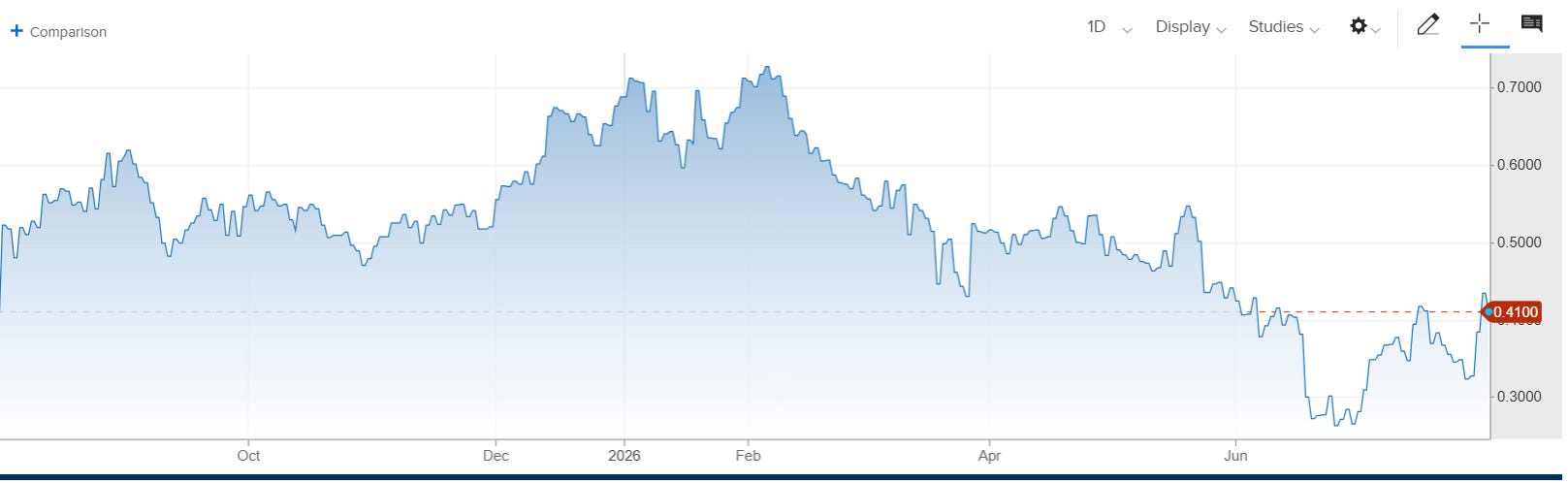
The Treasury market appears considerably less enthusiastic than headline commentators. Perhaps the most overlooked aspect of the recent move concerns what happened to the 2s10s spread. The spread had narrowed significantly during periods when markets assigned elevated probabilities to additional Federal Reserve tightening. Following the latest FOMC meeting, however, the spread widened materially as two-year yields declined faster than ten-year yields. Historically, this pattern is consistent with the gradual removal of policy-induced distortions.
Source: CNBC
Another frequently overlooked consideration concerns the role of Treasury collateral within the global financial system. Treasuries are not simply government liabilities. They constitute the primary collateral asset underpinning global repo markets, derivatives margining and/or wholesale dollar funding. Their pricing also depends on collateral demand and, of course, dealer balance sheet constraints. Consequently, modest increases in long-end yields need not imply deteriorating sovereign creditworthiness. They may instead reflect the (evolving) microstructure of Treasury intermediation.
Ultimately, the rise of the 30-year Treasury yield above 5.2% appears far less dramatic than headlines suggest. Rather than signaling the collapse of confidence in US public finances, the recent move fits a much more coherent narrative: policy-sensitive maturities have begun adjusting downward as markets reduce the probability of further near-term tightening, while longer maturities continue participating in the gradual normalization of a yield curve that has remained deeply distorted for several years. Bull steepening is an evidence that markets are attempting to return toward a more normal term structure after an extended period in which monetary policy held the front end artificially elevated.
If anything, the recent behavior of the Treasury curve confirms that markets remain primarily focused on monetary policy uncertainty rather than fiscal sustainability. Inflation expectations remain comparatively well anchored. Growth continues exhibiting characteristics of temporary mini-cycles rather than durable expansion. Energy shocks continue functioning more as taxes on consumption than engines of persistent inflation. Under those conditions, interpreting the rise in the thirty-year yield as evidence of Treasury rejection risks confusing the shape of the curve with the message it is actually transmitting.
Thanks for this piece, you write bull steepening multiple times, which means that the whole curve rallies but 30y rallies less than the front-end. But what we have seen recently is twist steepening where front-end rallies while 30y sells-off. That kind of a price action would be consistent with doubts over Fed credibility, US govt. fiscal concerns. I wouldn't say a loss of confidence but definitely a pricing in of more term premium.
I agree with your point that a bull steepening of the curve is very normal as front end reacts more to policy tightening getting priced out. But 30y has been making new highs since the Fed first started cutting rates in this cycle
nicely described Alex