
Hedging the hedge-ification

I would like to shift the discussion in a slightly different direction and focus on the United Kingdom, where one of the most consequential (yet surprisingly overlooked) regulatory proposals is currently emerging. The proposal seeks to limit the amount of leverage that hedge funds can employ when taking positions in the UK government bond market. While this may initially appear to be a narrow (to be read: technical) issue, it raises questions about market liquidity and the stability of sovereign bond markets.
Of course, as usual, the Bank of England’s latest proposal to limit the amount of leverage that hedge funds can employ when financing UK government bonds has largely been interpreted as another attempt to reduce financial stability risks created by non-bank financial institutions. The immediate narrative is straightforward: highly leveraged basis trades amplify volatility during periods of market stress, and regulators therefore seek to constrain excessive borrowing before the next crisis emerges (about leveraged basis trades I discussed here).
There is certainly some truth to that interpretation. The liability-driven investment (LDI) crisis of September 2022 demonstrated how leveraged positions can rapidly transform what initially appears to be an orderly repricing into a disorderly liquidity event. Yet focusing exclusively on hedge fund leverage risks missing the institutional transformation that has taken place over the past fifteen years.
The Bank of England has repeatedly argued that leverage among non-bank financial institutions can create destabilizing feedback loops during periods of stress because margin calls force investors to liquidate government bonds precisely when market liquidity is already deteriorating. What deserves greater attention, however, is why those forced sales become so destabilizing today compared with earlier decades.
The answer lies in dealer intermediation. Before the GFC, primary dealers functioned as genuine shock absorbers. When large institutional investors sold government bonds, dealers expanded their inventories, financed those securities through repo markets, and gradually redistributed the risk across the financial system. Temporary imbalances between buyers and sellers rarely translated into severe market dysfunction because dealer balance sheets possessed considerable elasticity.
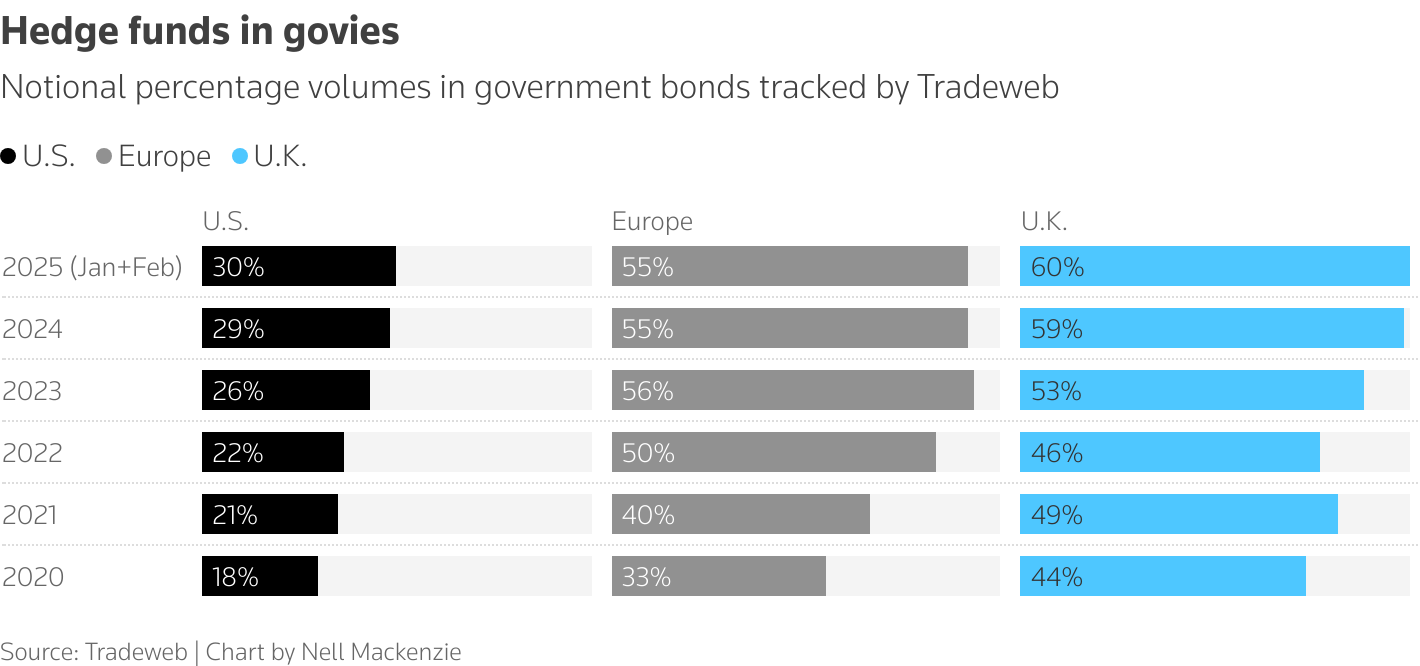
That world no longer exists. Post-crisis regulatory reforms fundamentally altered the economics of market making, we already went through a process of hedge-ification, as I discussed here. Supplementary leverage ratios, Basel III capital requirements, liquidity coverage ratios, G-SIB surcharges, stress-testing frameworks, you name it, have substantially increased the balance sheet cost of intermediating sovereign securities. Or, from a more technical point of view, Basel III rules and national regulations imposed leverage ratios, which cap banks’ balance sheets regardless of riskiness of assets, liquidity coverage and net stable funding ratios, which increase the cost of holding inventory and of course stricter risk limits and internal capital charges. As the chart below shows, hedge funds have become major players in these markets, especially in the UK:
Source: Reuters
The implications are profound. Market liquidity is no longer determined primarily by the willingness of investors to hold government debt. Instead, it depends on the willingness and ability of regulated intermediaries to temporarily warehouse that debt.
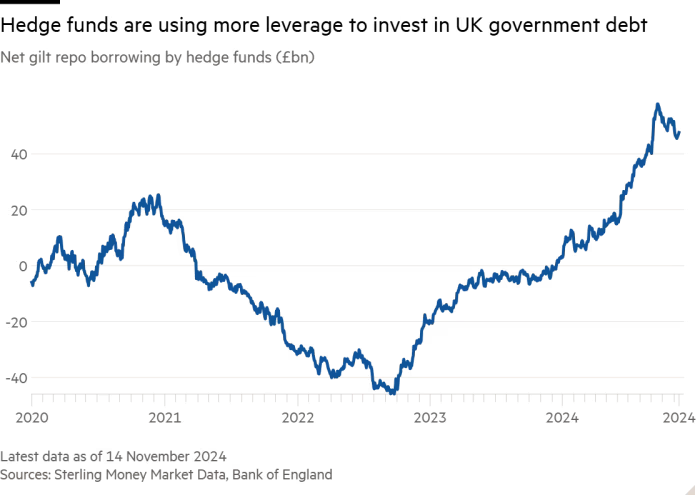
This distinction fundamentally changes how we should interpret hedge fund leverage. Much of the recent discussion focuses on relative-value trades, particularly basis trades that exploit pricing differences between cash government bonds and futures. These strategies typically employ significant leverage obtained through repo financing. Under normal market conditions, the trade appears relatively low risk because the spread between the two instruments eventually converges. However, the stability of the strategy on uninterrupted access to funding. As documented by the Financial Stability Board’s work on non-bank financial intermediation, leverage transforms relatively small price movements into large funding shocks because lenders demand additional collateral whenever volatility rises.
Source: Financial Times
Once margin calls begin, leveraged investors must either obtain additional cash or liquidate positions. The resulting sales increase market volatility, which generates further margin calls, producing a classic liquidity spiral. The LDI episode provided perhaps the clearest recent example of this mechanism. The Bank of England itself concluded that the crisis was driven by forced collateral sales associated with leveraged liability-driven investment strategies.
Importantly, government bond yields rose not because investors suddenly questioned the creditworthiness of the United Kingdom but because balance sheet constraints prevented dealers from absorbing the extraordinary volume of sales. This distinction remains underappreciated. Traditional finance often interprets sovereign yields through expectations of inflation, fiscal sustainability, or even (or especially) future monetary policy. But there is a variable that deserves equal attention: intermediation capacity.
When dealer balance sheets become constrained, sovereign bonds can temporarily trade at prices that reflect funding scarcity (and not even related macroeconomic fundamentals). The same lesson emerged during the US Treasury market turmoil of March 2020. Investors around the world attempted to sell US Treasuries during one of the largest flights to liquidity in modern history because they needed USD funding liquidity. The resulting dysfunction forced the Federal Reserve to intervene aggressively, purchasing Treasuries not because government solvency was in question but because dealer balance sheets had reached their effective limits.
The common element linking March 2020 and September 2022 was therefore not excessive sovereign borrowing. Not even close. If anything, it was all about the insufficient balance sheet elasticity. Seen through this lens, the Bank of England’s proposal appears considerably more logical. Constraining hedge fund leverage effectively reduces the size of potential forced liquidations that dealers may eventually be required to intermediate. Rather than expanding dealer balance sheet capacity, a politically and regulatorily difficult objective, the authorities are attempting to reduce the magnitude of future balance sheet demands. But it represents a demand-side solution to a supply-side problem.
One potential concern is that leverage restrictions merely redistribute activity rather than reduce systemic leverage. Financial history repeatedly demonstrates that tighter regulation of one segment often pushes leverage toward less regulated institutions. Futures contracts that are used today by non-banking financial institutions to engage in US Treasury markets, as I discussed in my latest research paper (you can read it here). The growth of private credit following tighter bank regulation is another example of this phenomenon.
The same may occur within sovereign bond markets. If leverage becomes more expensive for UK-based hedge funds, trading activity could migrate toward offshore entities, alternative financing structures or synthetic exposures that remain outside the immediate regulatory perimeter. The Financial Stability Board has repeatedly emphasized that monitoring leverage within non-bank financial institutions remains considerably more difficult than within the banking sector because reporting standards remain fragmented internationally.
Another issue concerns market liquidity itself. And that’s because leverage is not inherently destabilizing. It is also used to finance the entire market-making activity. For example, relative-value arbitrage contributes to pricing efficiency by narrowing discrepancies between closely related securities. If leverage restrictions become excessively stringent, bid-ask spreads could widen while market depth deteriorates, particularly during normal market conditions.
As such, reducing leverage decreases systemic fragility but may simultaneously reduce secondary market liquidity. And an equally important implication concerns repo markets. Modern sovereign bond markets cannot be understood independently from secured funding markets because repo financing effectively transforms government securities into monetary instruments. A government bond is no longer simply a duration asset. It simultaneously functions as collateral supporting cash creation throughout the financial system. Consequently, restricting leveraged repo activity inevitably affects monetary transmission. This observation becomes particularly relevant during periods when central banks are simultaneously shrinking their balance sheets through quantitative tightening.
As reserves decline, repo markets assume an important role in reallocating liquidity across financial institutions. If leverage restrictions reduce repo intermediation at precisely the same moment reserves become scarcer, authorities may inadvertently tighten financial conditions more than intended. This interaction shows why monetary policy cannot be analysed independently from financial market structure.
Another dimension concerns the growing importance of non-bank financial institutions. Over the past decade, pension funds, insurers, asset managers and hedge funds have become progressively larger participants in sovereign bond markets, partly because banks have reduced balance-sheet-intensive activities following post-crisis regulation, as argued above. Ironically, regulation designed to reduce banking sector risk has increased the systemic importance of institutions that central banks traditionally supervise less directly.
The Bank of England’s proposal therefore reflects an institutional reality. Central banks find themselves responsible for stabilising markets whose dominant participants fall largely outside conventional banking supervision. This evolution raises questions about the future architecture of sovereign debt markets. Should authorities continue regulating leverage among end-investors while leaving dealer balance sheet constraints largely unchanged? Or should policy instead focus on expanding the capacity of regulated intermediaries to absorb temporary market imbalances?
Recent debates surrounding the SLR in the US demonstrate that these questions extend well beyond the United Kingdom. Numerous market participants have argued that relaxing selected balance sheet constraints during periods of stress could improve Treasury market resilience without materially weakening bank safety. Whether similar discussions eventually emerge in the United Kingdom remains uncertain. Nevertheless, the underlying issue appears remarkably similar.
Ultimately, interpreting the Bank of England’s proposal solely as an attempt to control hedge fund leverage risks overlooking the more significant transformation taking place across advanced financial systems. The central problem today is the interaction between leverage, collateral markets and, of course, the inelastic dealer balance sheets. The modern sovereign bond market functions as both a capital market and a monetary infrastructure. Government securities are collateral instruments and funding vehicles simultaneously. Once these multiple functions are recognised, episodes such as the Treasury market dysfunction of 2020, the UK gilt crisis of 2022 and the recurring episodes of repo market stress appear considerably less mysterious.
They all reflect the same reality, namely that financial stability depends on who possesses the balance sheet capacity to intermediate it when everyone else wants to sell at the same time. From that perspective, the Bank of England is attempting to compensate for a financial architecture in which the private sector’s ability to absorb sovereign collateral has become structurally less elastic than the markets it is expected to support. And that is because of the post-GFC regulations, whether we like it or not.